
New Refractory Alloy Shows ‘Exceptional’ Fracture Resistance at ‘Very Low’ Temperatures: TAMU Researchers

News MSENMEEN MainArt 7May2024

COLLEGE STATION, Texas — Alongside a team of researchers from across the nation, Dr. Enrique J. Lavernia, professor in the Department of Materials Science and Engineering and the J. Mike Walker ‘66 Department of Mechanical Engineering at Texas A&M University, has discovered a refractory alloy that contradicts this trend by exhibiting an unprecedented fracture toughness at very low temperatures due to its ability to form kink bands. 

According to a news release, the findings showcase that this novel class of materials can show resistance to fracture in a wider range of temperatures, broadening their real-life applications.

To conduct this study, the researchers used a multidisciplinary approach that involves synthesis and experiments to determine mechanical properties and detailed characterization using electron microscopy techniques to study these novel materials and their deformation behaviors.

The study investigated the mechanical properties of a refractory medium-entropy alloy made of niobium, molybdenum, tantalum and hafnium (NbTaTiHf). 
News MSENMEEN SecondArt 7May2024
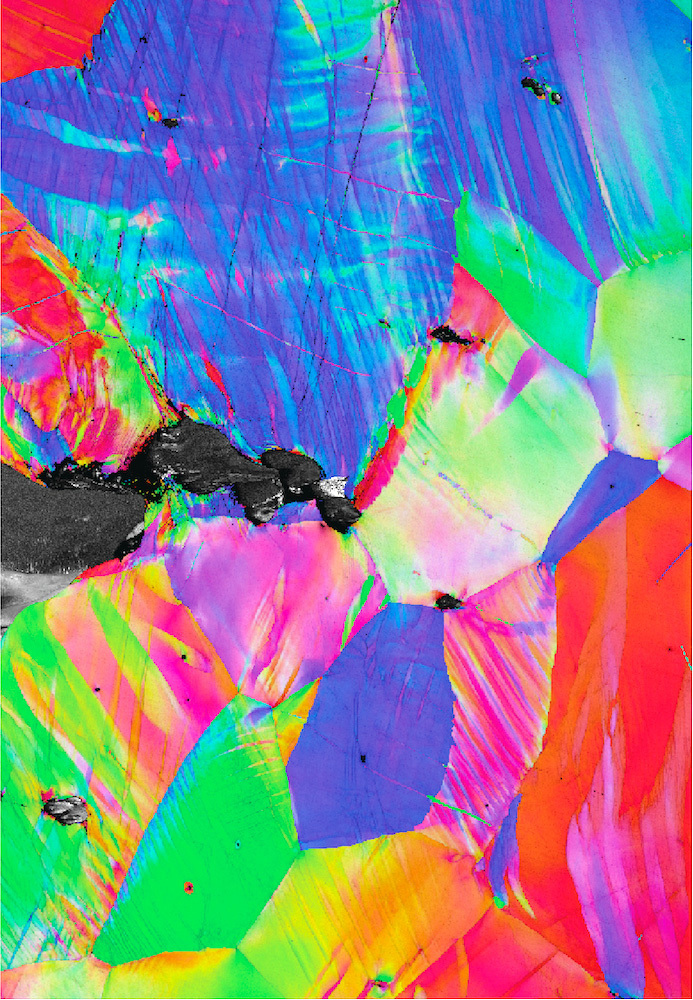
This material structure map shows kink bands formed near a crack tip during crack propagation (from left to right) in the alloy at 25 C, room temperature. Made with an electron-backscatter diffraction detector in a scanning electron microscope. | Image: Courtesy of Berkeley Lab.

To test the new alloy’s response to extreme environments, the researchers exposed the alloy to a wide range of temperatures, from 77 to 1473 Kelvin — the equivalent of – 321.07 Fahrenheit to 2191.73 Fahrenheit.    

Research revealed that the alloy could retain strength and fracture toughness at these temperatures because of its ability to form kink bands. Kinks bands are deviations of a dislocation effect within a crystal structure that contain a change in the positioning of atoms. These dislocations allow atoms to slide over each other at low-stress levels on a glide plane.  

The toughness of the discovered alloy is attributed to these dislocations, which promote strain hardening to form the kink bands, dispersing damage away from crack tips, researchers said.

News MSENMEEN ThirdArt 7May2024
This map shows kink bands formed near a crack tip during crack propagation testing (from left to right) in the alloy at -196 C. | Image: Courtesy of Berkeley Lab.

“Contrary to a generally accepted concept, body-centered cubic refractory alloys can possess extraordinary fracture toughness across cryogenic and high temperatures that arise from the coordinated glide of edge dislocations at a crack tip, which results in complex arrays of kink bands,” said Lavernia. 

This discovery of this potentially new mechanism could lead to increased applications for refractory alloys. 

Source: Texas A&M University

Similar Posts

  • Passage Of Paycheck Protection Program Improvements Will Save Many Construction Jobs And Protect Construction Employers

    FacebookXRedditPinterestEmailLinkedInWhatsApp With Needed Improvements to the Vital Survival Program Complete, Construction Official Urges Congress and the President to Act Quickly on Measures to Rebuild the Economy and Restore Jobs The chief executive officer of the Associated General Contractors of America, Stephen E. Sandherr, issued the following statement in reaction to the passage of the Paycheck…

  • Houston Airport System News: Travel Rebound Steadily Growing in Houston

    FacebookXRedditPinterestEmailLinkedInWhatsApp Travel rebound is steadily growing and nearing pre-pandemic levels. Houston Airports uses three measurements to gauge passenger travel: Enplanements, Capacity and Load Factor.  June 2021, enplanements — the boarding of an aircraft by a passenger— gained 2.24M, an increase of 15% over the previous month.  Capacity —the number of seats made available by carriers…

  • Sleep deprivation among U.S. workers a growing problem, study finds

    FacebookXRedditPinterestEmailLinkedInWhatsApp More than 1 out of 3 U.S. working adults aren’t getting enough sleep, and the prevalence of sleep deprivation has increased significantly since 2010, according to researchers from Ball State University. The researchers analyzed 2010-2018 data from more than 150,000 working adults who participated in the National Health Interview Survey to determine the frequency of short…

  • Newly Launched PIPES Online System Improves Access to RRC’s Pipeline Records, Enhances Transparency

    FacebookXRedditPinterestEmailLinkedInWhatsApp By Subcontractors USA News Provider In yet another move to take advantage of improvements in technologies, the Railroad Commission today launched its new Pipeline Inspection Permitting Evaluation System (RRC PIPES). RRC PIPES is a centralized cloud-based portal, which streamlines agency processes and provides a valuable tool for RRC’s Pipeline Safety staff and operators to…