

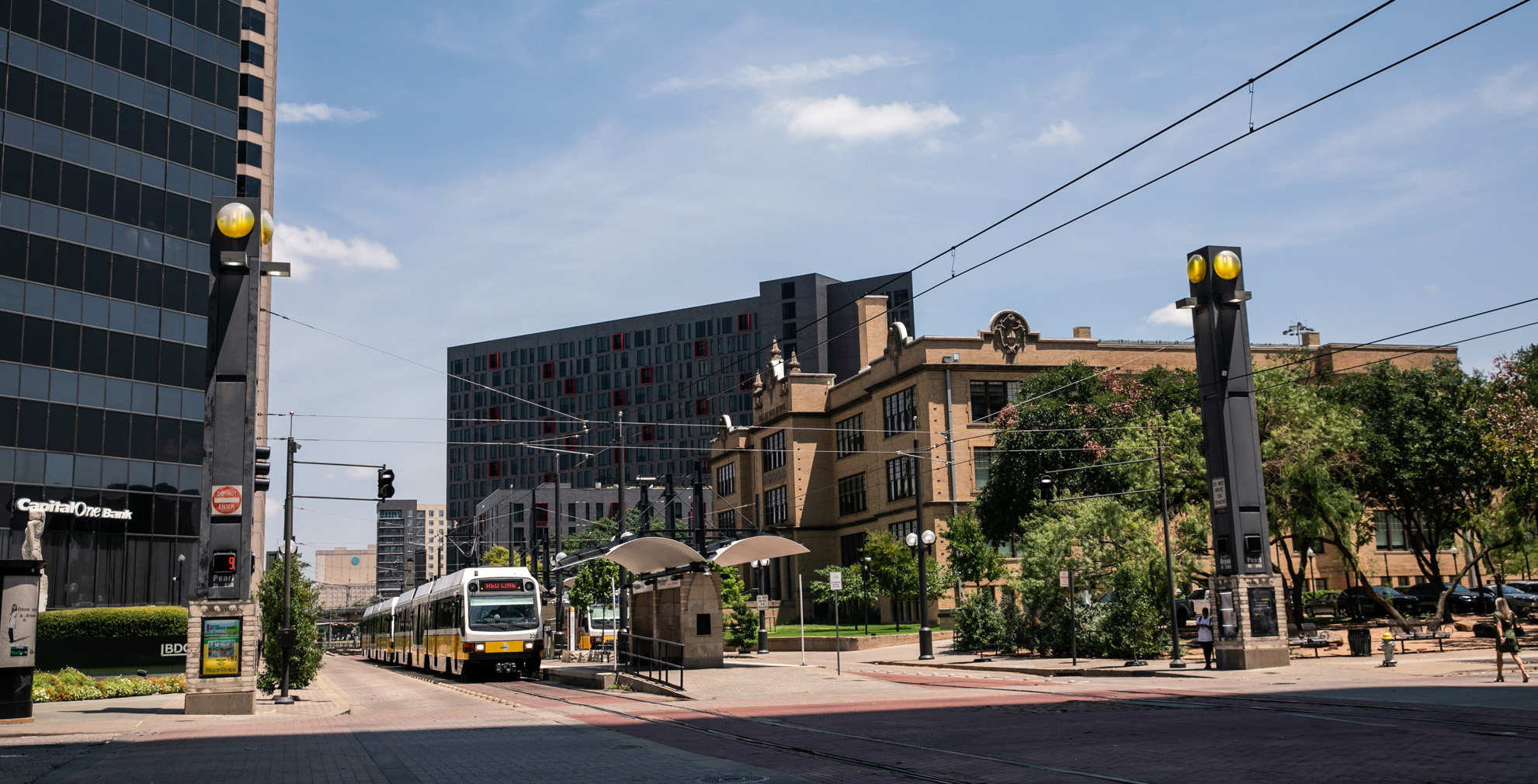
ADDISON, Texas — Dallas Area Rapid Transit President and CEO Nadine Lee announced findings on Friday, September 6, at DART’s second annual State of the Agency event in Addison, Texas.
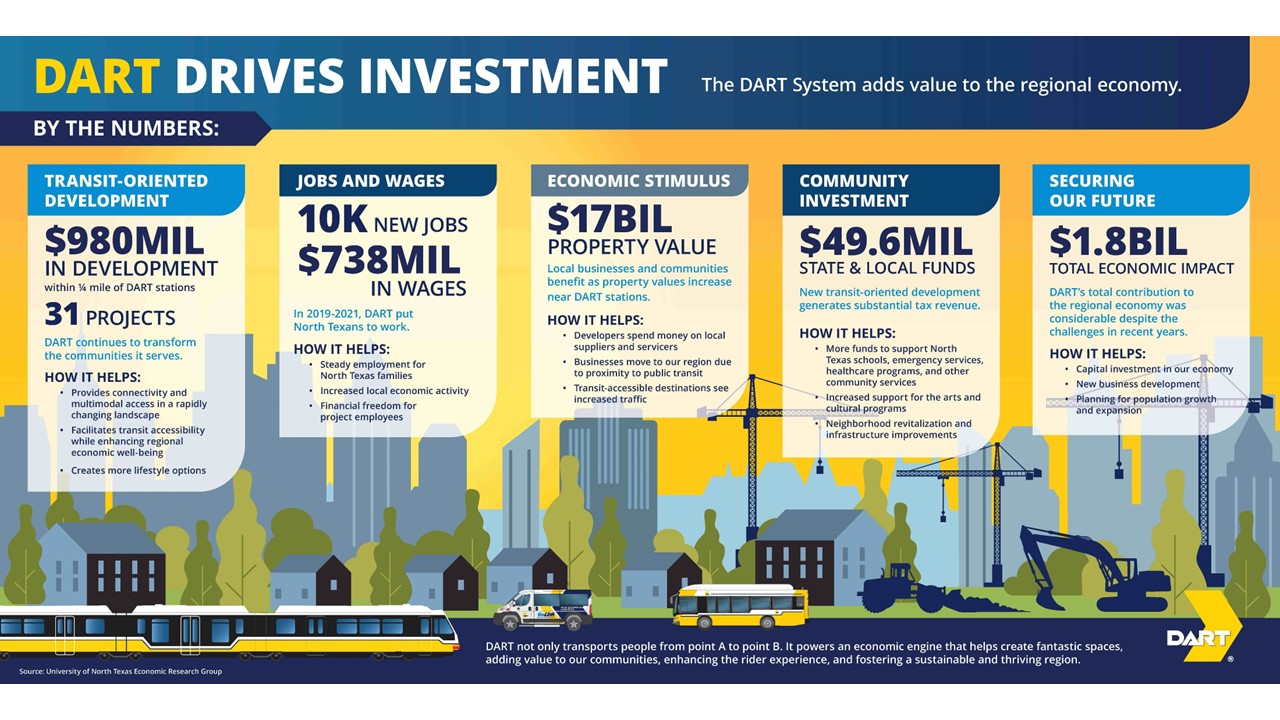
Transit-oriented developments in the DART service area generated nearly $1 billion in direct spending and spurred 11,000 jobs between 2019 and 2021, Lee announced during her second annual State of the Agency address on Friday.
According to a news release, the data comes from a recent study conducted by the University of North Texas Economic Research Group (ERG). It revealed the significant economic benefits of development projects near DART light rail stations. This study, led by Michael Carroll, Ph.D., evaluated real estate development within a quarter-mile radius of DART stations, confirming long-held beliefs among economists and real estate developers about DART’s impact on the region’s economic vitality.
“Transit services provided by DART are critical to regional mobility. DART’s network is designed to connect riders across city boundaries and provide crucial access to jobs, education, health care, entertainment and more,” said Nadine S. Lee, DART President and CEO. “DART opens up social and economic development opportunities at all of our stations.”
The study results are among numerous highlights from the State of the Agency address, sponsored by Archer Western Construction and held this year at the Renaissance Dallas Addison Hotel. Addison Mayor Bruce Arfsten and DART Board Chair Gary Slagel were among other featured speakers.
Lee, in her fourth year as DART president and CEO, also noted the agency’s long history of fiscal responsibility.
“We project every dollar we will spend over the next two decades and our board members approve that plan every year,” Lee said. “We plan and budget well within our means – and we have a long history of doing so.”
She pointed to the ERG study in highlighting the tremendous value DART brings to all 13 service area cities.
“This study further confirms long-held beliefs among economists and real estate developers about DART’s impact on our regional economy,” she said. The ERG study focused on 31 real estate development projects built near DART stations between 2019 and 2021. These projects encompassed a mix of commercial, residential, and public developments. The findings below illustrate the profound economic impact of these developments.
Direct Spending: DART’s transit-oriented projects generated over $980 million in direct spending.
Total Economic Impact: The cumulative economic impact within the 700-mile DART Service area, tracked by UNT since 1999, reached $17.1 billion, significantly boosting the Dallas-Fort Worth (DFW) region’s economy.
Job Creation: These developments created 10,747 jobs in the DFW area.
Tax Revenue: The DART station area economic impact between 2019 and 2021 contributed $144.7 million in federal tax revenue and $49.6 million in state and local tax revenue.
Despite the challenges posed by the COVID-19 pandemic, the DFW region demonstrated remarkable economic activity from 2019 to 2021. Carroll emphasized that this growth is part of the region’s broader, long-term trend of robust economic expansion. He noted that the trend of developing properties near light rail stations is not unique to DFW, as similar patterns are observed nationwide.
The study utilized IMPLAN software to create detailed economic models based on development spending data. IMPLAN is a widely used industry tool that calculates direct, indirect, and induced impacts of spending and employment. The results underscored the continuous economic growth and development around DART stations.
“Proximity to DART adds value to development,” said Lee. “The impact of DART light rail investments on local development shows residential and office space rent for substantially higher than surrounding projects. In total, development projects near DART stations since 1999 have resulted in an aggregated increased property value of $17.1 billion with additional contributions to the economy through direct and indirect means such as wage, tax, and other economic factors.”
Carroll highlighted the growing importance of connectivity and multi-modal access in Texas’s rapidly urbanizing landscape, particularly in the DFW area.
“Over the decades, the development near DART light rail stations, including significant commercial, office and residential establishments, has not only provided transit accessibility but also simultaneously boosted the economic wellbeing of the DFW region,” Carroll stated.
As the DFW region continues to urbanize, leveraging transit as a strategic mobility asset will not only enhance regional connectivity and accessibility, but is essential to sustaining our economic momentum through coordinated planning and development with our cities and alongside key stakeholders.
Source: DART