
A longtime Houston artist collective has struck again.
Dan Havel and Dean Ruck of Havel Ruck Projects have been creating deconstructive art installations for more than a decade, utilizing neglected buildings destined for demolition. Their projects are artistic interventions into the architectural framework of derelict structures, warping their tectonic or material fabric to create interactive, unpredictable, and reorienting spaces.
The duo’s first Houston project was “O House” (1995). It transformed a small condemned home into a large-scale camera obscura. Havel and Ruck gutted the interior, constructed a continuous circular wall to create a dark inner room, and drilled holes in the roof, letting in beams of light that cast projections of the trees and sky from outside. Like all their projects, the installation was temporary, in this case lasting two months before the house was demolished.
Since then, Havel and Ruck’s projects have inverted building structures, created sculptures from remnants of death-rowed houses and scrap yard metals, created tunnel-like voids in homes, and cut ribbons out of existing walls and elevated strips of floorboard in whimsical curved shapes.
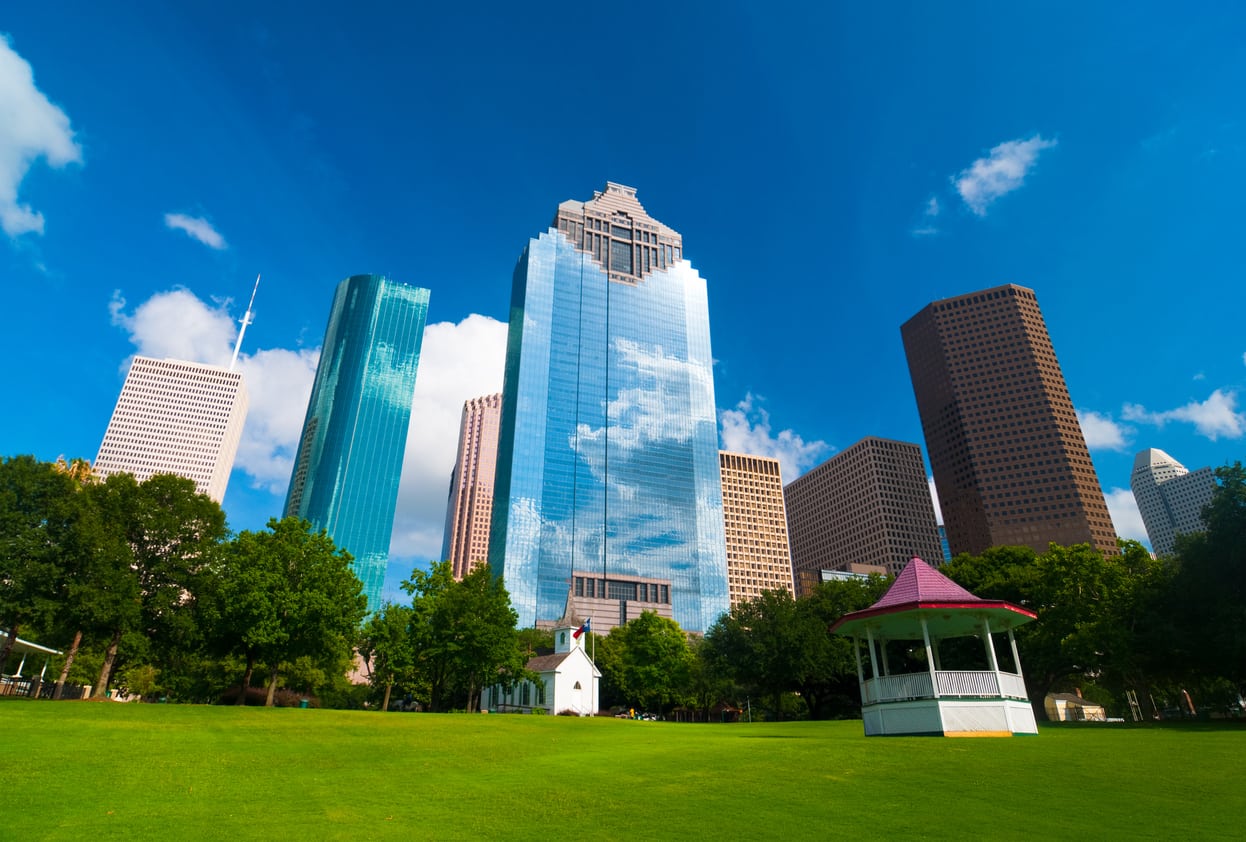
Their latest project is “Open House.” It’s a 1940s home, relocated from Santa Fe, Texas, and placed in downtown Houston’s Sam Houston Park. In April, the artists started manipulating the building’s materiality and reformulating the interior to create a one-room space defined by an array of circular holes punched through the perimeter and a collage of vintage photographs wallpapering the interior.
The deconstruction of the walls through the repeated puncturing of variously sized holes reads as polka dots or Swiss cheese from outside. It’s an engaging, lighthearted iteration of architectural deconstructionism, an art which goes back to Gordon Matta-Clark, whose 1974 project “Anarchitecture” was the first widely seen sculptural dissection of existing architecture.
With the vintage photographs, Havel and Ruck bring a human element to this project not present in their previous work. On the inside of the playful, ventilated walls, the weight of humanity present in the images brings a sense of gravity to the space. It gives one pause. The building intervention is not just an interesting manipulation of the material, but a physical frame of reference for the immaterial — for past lives, places, moments.
The photographs create a conversation with the project’s site — Sam Houston Park — where nine historic buildings from as early as 1823 sit as rare emblems of the past in the architecturally young city of Houston. From the history within you can see the history without.
Open House is the latest project in the Art Blocks series, a temporary public art initiative launched in February 2016 by the Houston Downtown Management District. The project will be on view through February 2019 and is free and open to the public.
Source: Texas Architects