
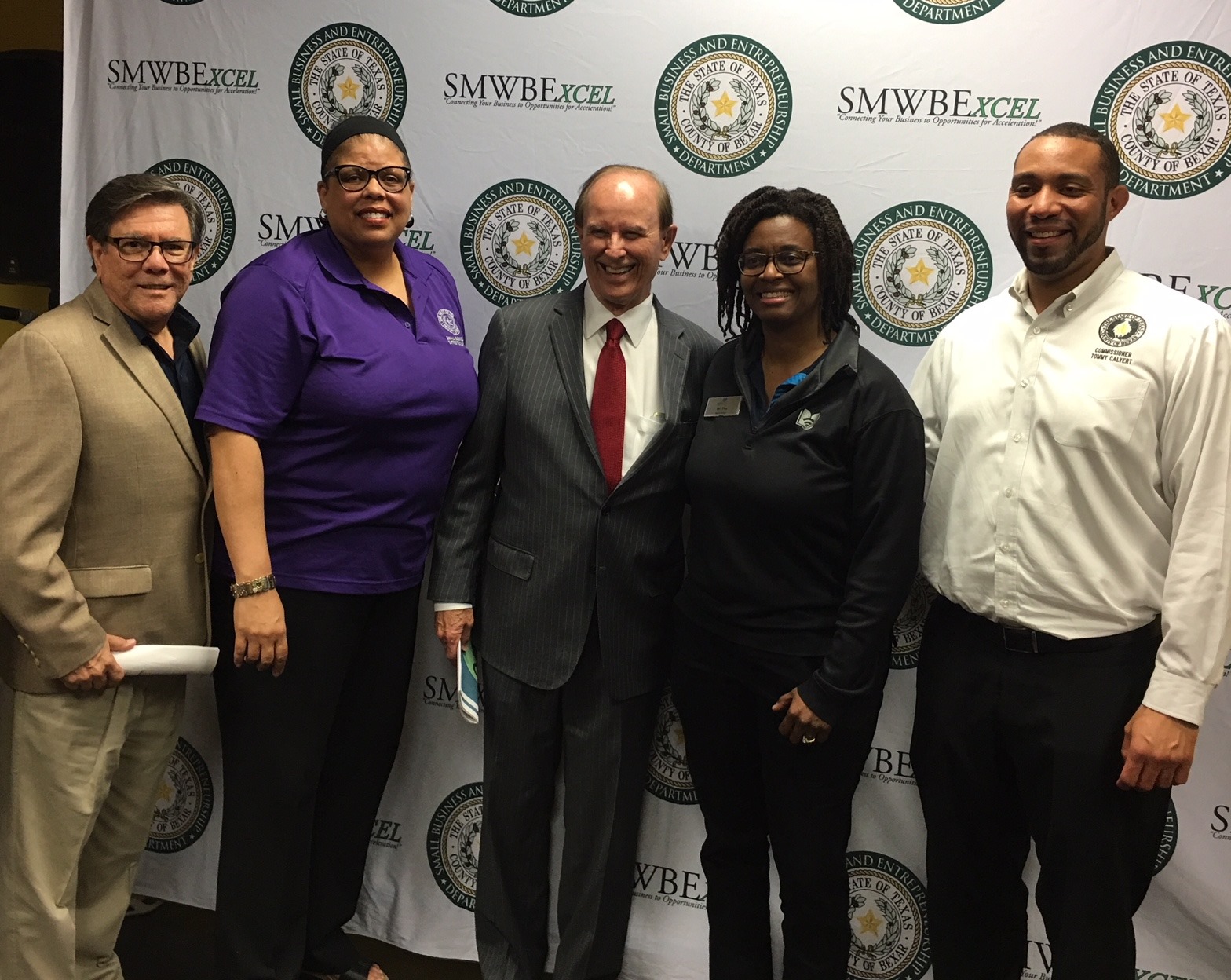
Since 2001, Bexar County’s Small Business and Entrepreneurship Department has made it their mission to create an environment where small businesses can thrive, leading to a more sustainable economic future for Bexar County. The department works to increase small, minority and women owned business participation in county projects and procurement through public, non-profit and private sector efforts and resources.
The Small Business and Entrepreneurship Department is also responsible for administrating the Small, Minority and Women Owned Business Enterprise (SMWBE) Program and the Disadvantaged Business Enterprise (DBE) Program.
“We are an action-oriented team dedicated to linking small, minority and women owned business enterprises, disadvantaged business enterprises and historically underutilized businesses to opportunities that will ensure success in the government marketplace and the private sector,” Renee Watson, Director of the Small Business and Entrepreneurship Department, said.
Watson has made it clear through the work in her department that they believe small, minority, women, disadvantaged and veteran owned business are an integral part of life, as they play an important role in the economy of the United States and are considered by many as the heart of the free enterprise system, employing well over half of all working Americans. Bexar County alone has over 45,000 small businesses providing products and services to the community.
Through the SMWBE Program, the department works to increase the involvement of SMWBEs in the procurement process, with the goal being to afford these businesses a fair opportunity to compete for all Bexar County contracts.
“Bexar County recognizes the importance of SMWBE/DBE firms, advocates for the growth of these businesses and works to build partnerships with numerous federal, state, local and private sector organizations where opportunities are provided for SMWBE/DBE firms to access and compete for contract,” Watson said.
Bexar County has set a participation target of a minimum of 20% of all procurement dollars in the areas of commodities, equipment, services, maintenance and construction are spent with minority and women-owned business enterprises and a minimum of 30% of those procurement dollars are spent with small business enterprises.
To reach this target and execute it most effectively, the SMWBE Program works closely with other entities such as the SMWBE Program Advisory Committee, Purchasing Department and other local governmental entities to develop and implement various outreach and procurement programs. This ensures that area resources are maximized and not duplicated.
Some of the outreach efforts and procurement programs these entities work to develop include the Small, Minority, Women and Veteran Business Owners (SMWVBO) Business Conference, SBED Meet The Buyers events, supplier breakfasts and many more.
The department’s next event is the SMWVBO Business Conference 2019 to be held on December 11. This is a forum created to develop relationships, acquire knowledge and access opportunities that exist with public and private sector entities for the procurement of goods and services. It further enhances the knowledge of procurement staff on the availability and ability of local firms with the desire to do business.
“The SMWVBO Conference is an opportunity for the county Purchasing Department to make direct contact with local vendors,” Watson said. “SMWBEs can get their questions answered and meet the buyers who make decisions daily to solicit or recommend award that will directly impact their business. It also provides a place for other county departments to provide information regarding their services or programs for SMWBEs. It’s really an opportunity SMWBEs don’t want to miss.”
For more information about Bexar County’s Small Business and Entrepreneurship Department, their programs and other upcoming events, visit https://www.bexar.org/129/Small-Business-Entrepreneurship-Dept