
Employment in Texas’ Upstream Oil and Natural Gas Activities Impacted by Pandemic

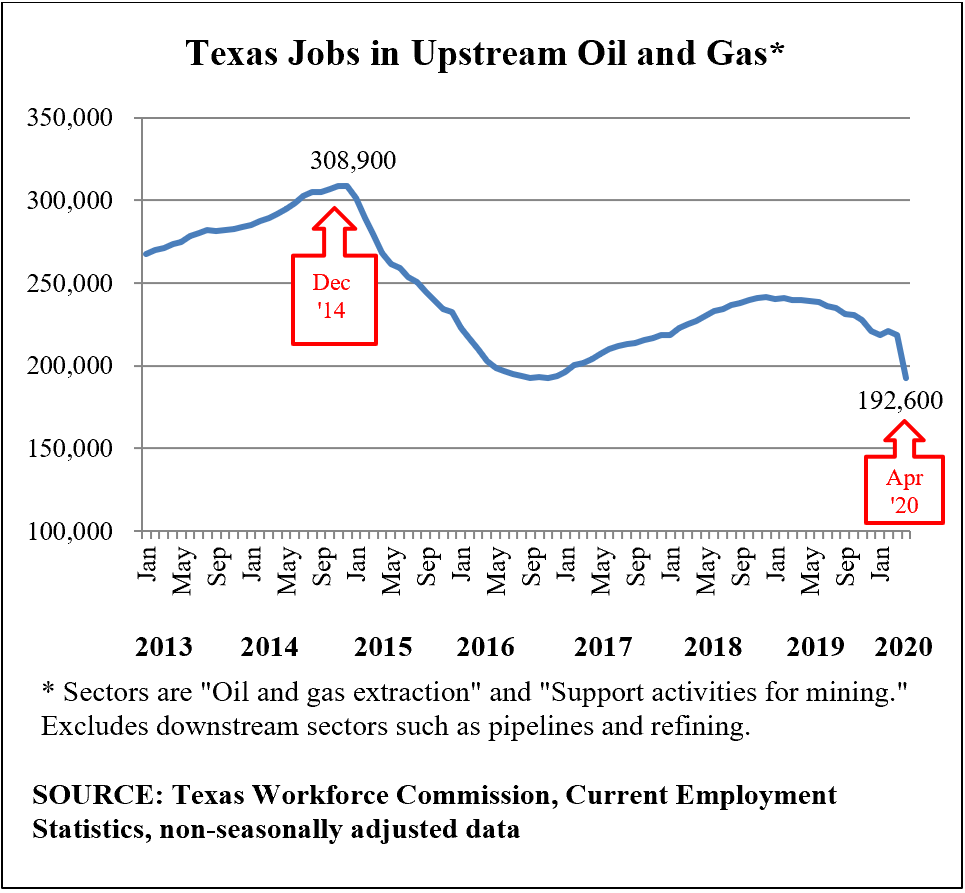
Data from the Workforce Commission indicates that employment in Texas’ upstream oil and natural gas activities fell significantly in April.
5 22 upstream jobs

Compared to March 2020 levels, April upstream employment was down by 25,800 jobs.  Compared to the same month in 2019, April 2020 jobs were down 47,200, or 20%.  At a total of 192,600 jobs, this was the first time for upstream jobs to number fewer than 200,000 since January 2017.  The April 2020 upstream job count now essentially matches the low point of September 2016, which was 192,400 jobs.  These jobs pay among the highest wages in Texas.

Todd Staples, president of the Texas Oil & Gas Association, said, “This current crisis is impacting every sector of the oil and natural gas industry, and unfortunately, many companies are required to make difficult decisions as they adjust to the market circumstances. The Texas oil and natural gas industry has positioned itself to manage through the world-wide disruption by immediately announcing rig reductions, curtailing planned capital expenditures for 2020 by over $60 billion and counting, shutting in actual production and by pursuing innovative storage expansion. While many of these necessary reductions have negatively impacted workforce levels, the industry is poised to rebound as the world economy gets back on track and supply/demand levels normalize. We look forward to expanding the employment levels as market conditions allow.”

Oil and natural gas extraction is upstream activity, meaning that it excludes other sectors in the industry such as refining, petrochemicals, fuels wholesaling, oilfield equipment manufacturing, pipelines, and gas utilities.  The employment shown also includes “Support Activities for Mining,” which is mostly oil and natural gas-related but includes some small amount of other types of mining, also.

Of the year-over-year loss of 47,200 jobs, the lion’s share was in the “Support Activities of Mining” sector, mostly service companies.  April 2020 employment by these companies was down 26% compared to the same month, prior year.  For “Oil and Gas Extraction,” which is mostly operators, the year-over-year decline was just 6%.

The “Petroleum and Coal Products Manufacturing,” a subsection of the downstream sector, lost 1,400 jobs (6%) in April 2020 compared to March, an unusual job swing for this sector.
Similar Posts

  • RRC Completes Successful Year Exceeding Goals To Protect Texas, Maximize Resources

    FacebookXRedditPinterestEmailLinkedInWhatsApp With Fiscal Year 2022 in the books, the Railroad Commission continued its track record of surpassing critical goals that help protect public safety and the environment while also helping the state maximize the use of its natural resources. The RRC – which regulates the state’s oil and gas industry; critical natural gas infrastructure; intrastate…

  • AIV, Gulf Coast Modification to Consolidate Operations Within Expansive New Northwest Houston Facility

    FacebookXRedditPinterestEmailLinkedInWhatsApp By News Provider HOUSTON, Sept. 19, 2017 /PRNewswire/ — AIV, LP, a Houston-based global wholesale distributor of valves and actuators for the oil and gas, power generation, chemical, petrochemical, refining, pulp and paper and water treatment industries, has announced plans for a new 320,000+ square-foot facility at 22806 Northwest Lake Drive near Telge Road and Highway 290 in…

  • TXOGA Analysis Finds Texas Production of Oil and Natural Gas Has Achieved New Record Highs, Leading U.S. Production

    FacebookXRedditPinterestEmailLinkedInWhatsApp AUSTIN – Texas’ production of oil, natural gas, and natural gas liquids (NGLs) has achieved new record highs, according to a recent monthly energy economic analysis prepared by Texas Oil & Gas Association (TXOGA) Chief Economist Dean Foreman, Ph.D. TXOGA estimates that Texas set new production records in August 2023, with Texas’ crude oil…

  • API Enhances Pipeline Safety With Two Updated Standard

    FacebookXRedditPinterestEmailLinkedInWhatsApp The American Petroleum Institute (API) recently released two revised liquid pipeline leak detection standards to improve operational integrity and advance operators’ mitigation capabilities. “Leak detection in liquid pipelines enables operators to quickly respond to incidents, minimizing any impact on local communities and the environment,” said Anchal Liddar, senior vice president of API’s Global Industry…

  • Railroad Commission Launches Drone Program to Enhance Emergency Response

    FacebookXRedditPinterestEmailLinkedInWhatsApp Taking advantage of 21st century technology, the Railroad Commission of Texas launched a statewide drone inspection team last month. Drones will help inspectors to quickly respond and inspect sites that are unsafe or inaccessible during emergencies such as fires, flooding and other natural disasters. Drones can also assist in situations, such as the current COVID-19…