
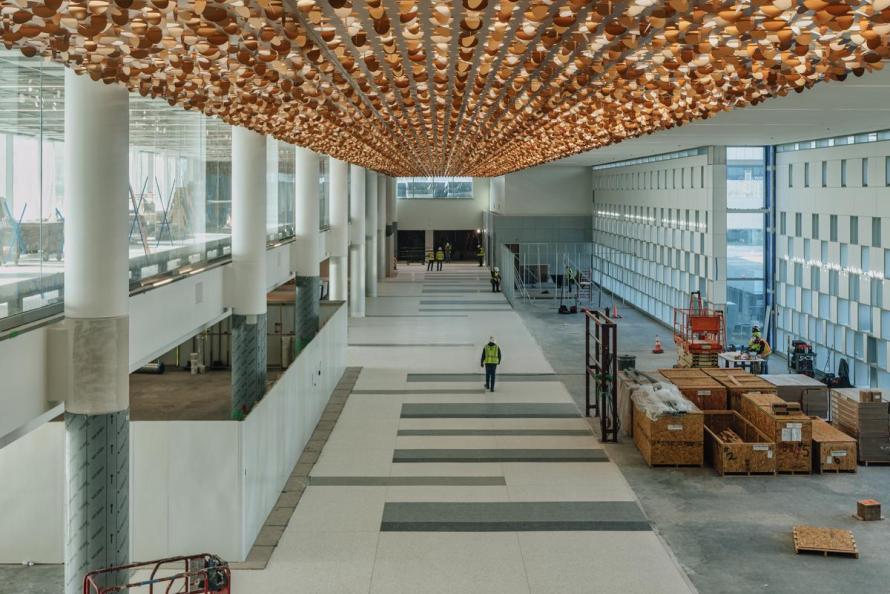
HOUSTON — Houston City Council approved additional funding for the IAH Terminal Redevelopment Program (ITRP). The additional funding will support Houston Airports as it works to deliver a world-class facility that will accommodate increasing demand from passengers and airlines, support continued economic growth for Houston and offer an efficient, intuitive and functional experience from curb to gate. Set to be completed in 2025, the new international terminal at George Bush Intercontinental Airport (IAH) be one of the most modern in the U.S.
At $1.458 billion, ITRP is the largest capital improvement program in the history of Houston Airports. Despite the COVID-19 pandemic, global supply chain issues, socio-economic issues and a volatile market, the program’s budget has only increased by 6.5% from the original baseline budget of $1.36 billion. The program’s budget overrun is significantly lower than the average overrun for airport construction projects, which is 39% globally.
“Council’s approval and support is a critical step forward for the IAH Terminal Redevelopment Program,” said Jim Szczesniak, Director of Aviation for Houston Airports. “Change is coming to Bush Airport. This funding will ensure Houston Airports continue the contracts necessary to get ITRP to the finish line, which is scheduled for 2025.”
The ITRP is comprised of three main components:
- A refresh of the existing Terminal D (completed in 2023)
- An expansion of Terminal D with a new D-West Pier (summer 2024)
- A new International Central Processor (winter 2024 and summer 2025)
The completion of the Terminal D-West Pier will provide six new international-capable widebody aircraft gates that can also be converted to 10 narrowbody aircraft gates. The International Central Processor ticketing hall will allow United Airlines to move its Terminal E passenger processing to the new facility, improving the overall customer experience and traffic flow. An improved baggage handling system and more dedicated lanes along the Departures and Arrivals curbs will also accommodate passenger growth.
“Once complete, ITRP will be a game-changing investment for Houston as it welcomes millions more visitors through a world-class facility,” said Szczesniak. “Houston Airports hold strong as a primary economic engine for the City of Houston, generating $36.4 billion in annual economic impact for the region. Our new terminal is only anticipated to widen our crucial impact on Houston’s economy.”
Houston Airports expects to recover the construction costs of the new terminal through revenue generated by fees paid by airlines and passengers, concessions and parking. No City of Houston General Fund dollars support Houston Airports. ITRP is creating opportunity for more flights, airlines, concessions and parking spaces and because of that, Houston Airports is anticipating a boost in revenue to balance the expense of ITRP.
By: Houston Airports