
AUSTIN — The Texas Department of Transportation is introducing a new process to help select roundabouts and other innovations to improve safety at intersections — where one-third of Texas’ fatal and injury crashes happen.
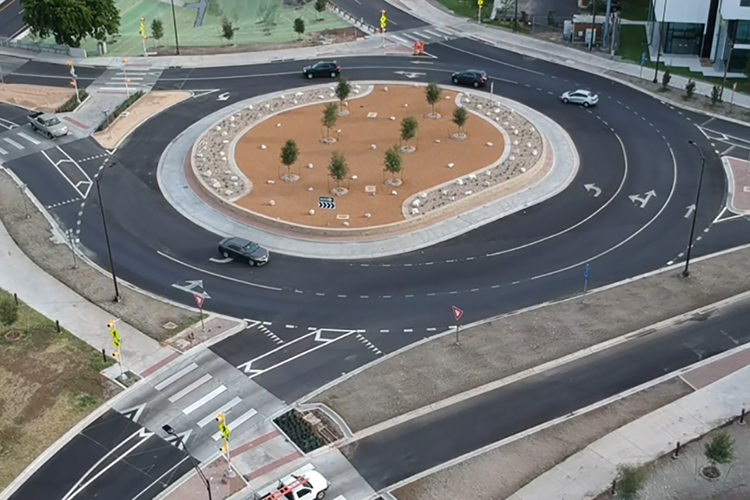
According to TxDOT, roundabouts can reduce fatal crashes at intersections by up to 90%. During National Roundabouts Week, September 16 – 20, TxDOT is highlighting its safety benefits as the agency works to implement them where appropriate throughout the state.
“If we want to get to zero deaths on our roadways, we have to look at all kinds of different innovative approaches to reach that goal and roundabouts are certainly one way to do that,” said TxDOT Deputy Executive Director for Planning and Administration Brandye Hendrickson.
Texas now joins the ranks of 13 other state DOTs using the Intersection Control and Evaluation process — or ICE — an approach that ensures intersection investments address safety and congestion priorities.
Other states using ICE include Pennsylvania, Florida and Hendrickson’s native Indiana, where she served in multiple roles — including commissioner — within the Indiana Department of Transportation.
“I got a chance to drive roundabouts in the communities where I live and that I serve,” she said. “It really opened up my eyes to the safety impacts and benefits that come along with these innovative intersections.”
Innovative intersections improve safety by eliminating, adjusting or relocating conflict points.
Roundabouts lessen the potential for collisions by forcing drivers to slow down and yield to those already in the circle while also reducing the most severe types of intersection crashes such as right-angle and head-on collisions.
Other innovations include Reduced Conflict U-Turns characterized by the prohibition of left-turn and through movements from side street approaches as permitted in conventional designs. RCUTs reduce fatal and injury crashes by up to 63%, according to FHWA data.
The ICE process will encourage engineers to consider roundabouts and other alternatives, while edging away from the status quo of implementing traffic signals in response to intersection safety issues.
“We can’t keep doing the same thing with our designs and expect different results,” said Mo Bur, TxDOT’s director of project development. “Thirty-two percent or a third of our fatal and injury crashes in Texas take place at intersections.”
TxDOT created a 40-member task force that would develop and implement the ICE process targeting a reduction in intersection fatalities.
Texas is already home to an estimated 860 innovative intersections and 643 roundabouts, with areas such as Bryan, El Paso and San Antonio leading the way with multiple innovative intersection projects under development.
“There is a lot more to installing a roundabout than the simple circle would suggest,” said Amanda Austin, who serves as TxDOT’s RAID lead. “You need it just big enough to accommodate trucks but not so big that people can drive too fast through it.”
And while good curvatures to slow vehicles and proper signage and pavement markings are the hallmarks of a good roundabout, such installations require fine-tuning to accommodate urban, rural or metro settings.
“There’s a lot of nuances,” Austin said. “That’s why we’re going to have an entire class on how to design roundabouts.”
The road ahead, Austin said, includes educating the public on how to navigate the less traditional intersections while empowering people with the resources and training to help build these correctly and save lives on Texas roads.
Source: TxDOT