

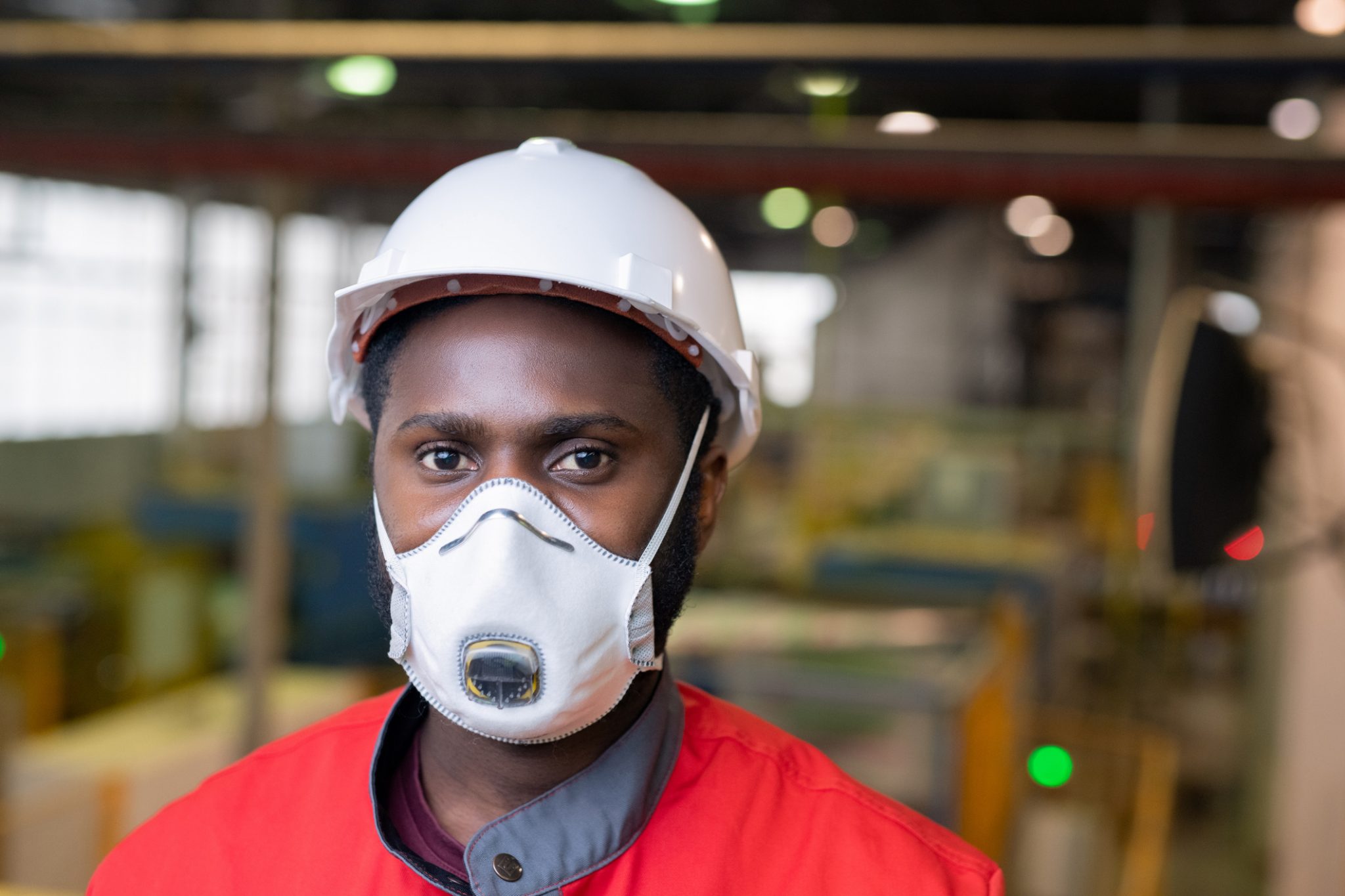
While any face covering will help contain the usual droplets that come from coughing, sneezing and even speaking, there are things to look for in a face covering to maximize jobsite safety from the coronavirus.
Researchers at Florida Atlantic University’s College of Engineering and Computer Science, using flow visualization testing in a laboratory equipped with laser light and a mannequin, recently published their findings as to which masks were the most effective.
High-quality face coverings are especially important for industries such as construction, where employees are often in close contact. Jim Goss, senior safety consultant at HCSS Construction Software, told Construction Dive that face coverings are a critical component of contractors’ COVID-19 safety plans and are imperative for situations when workers cannot maintain a distance of 6 feet or more.
The masks tested at Florida Atlantic were:
- A single-layer bandana-style face covering.
- A folded cotton handkerchief.
- A homemade mask constructed of two-layers of 70-thread per inch cotton quilting fabric.
- A non-sterile cone-style mask.
The researchers also conducted tests with no face covering.
Using a mixture of distilled water and glycerin to simulate a typical cough spray, researchers found that droplets traveled more up to 12 feet without a mask, well past the social distancing guideline of 6 feet.
With the single-layer bandana, droplets traveled 3 feet and 7 inches. When the tested mannequin was wearing a folded cotton handkerchief, the cough jet traveled 1 foot and 3 inches. The homemade mask made of stitched, quilted cotton allowed droplets to travel 2.5 inches, and the cough jet reached 8 inches when the mannequin was wearing a cone-style mask.
In the end, the researchers found the tighter the fit, the better the mask performance. Thicker material also fared well.
The research aligns with the latest guidance from the Centers for Disease Control and Prevention (CDC) regarding face coverings for the general public. In fact, the agency provides instructions for making a cloth mask on its website.
Face coverings are recommended and even required on construction sites across the country, and construction pros responding to a recent Construction Dive survey said they are an important means of protection from COVID-19. About two-thirds of respondents also said they are required on their jobsites, either by their firms or by local government protocols.
“The face covering does not protect you, it protects others from you,” noted AECOM Senior Construction Manager John Tull. “I have a family that I want to go home to and I don’t want to worry about what I could be taking home.”
N95 respirators
Last month, OSHA published a series of frequently asked questions and answers regarding the use of masks in the workplace. The new guidance outlines the differences between cloth face coverings, surgical masks and respirators.
Used for many construction-related activities even before the COVID-19 outbreak, N95 masks are facepiece respirators that filter at least 95% of airborne particles. OSHA has offered guidance for employers when workers are engaged in activities that require an N95 mask but shortages may prevent them from accessing the masks in the numbers needed.
The agency said that employers may use alternative classes of respirators that provide equal or greater protection compared to an N95 mask, such as NIOSH-approved, non-disposable, elastomeric respirators or powered, air-purifying respirators. Other alternative respirators are N99, N100, R95, R99, R100, P95, P99 and P100 masks.
If an acceptable alternative is not available, employers can use masks that are past the manufacturer’s extended shelf life, reuse N95 masks or use N95 masks for an extended period of time. Cloth masks, OSHA said, are not considered personal protective equipment (PPE) and cannot be used in place of respirators when respirators are required.
Other options
According to the American Chemical Society, there are other options that come close to the efficacy of an N95 mask, such as double layers of 600 thread-per-inch cotton and a cotton and polyester-spandex hybrid.
Some contractors have also been providing face shields to their workers for added protection for the face and eyes. Steve Sorrentino, director of specialty films for Madico, a manufacturer of laminates and coatings, said that, unlike masks that cover only the mouth and nose, face shields cover eyes, nose and mouth providing a barrier to prevent the spread of infectious diseases or viruses. Madico is manufacturing the Safe-Gard face shield.
In addition, Sorrentino said, face shields eliminate the mask issues of fogging of eyeglasses and breathing one’s own carbon dioxide.
The CDC does not recommend face shields for use by the general public as a mask replacement unless they wrap around the sides of the wearer’s face and extend to below the chin.
Even when using an effective mask, there are additional recommended practices that will maintain their efficacy. Jay Woody, chief medical officer at Intuitive Health and co-founder of Legacy ER & Urgent Care, both in the Dallas area, offered the following tips to enhance masks’ safety:
- Use nonwashable masks only once.
- Machine wash cloth masks after each use.
- Wash hands before donning a mask, before removing it and after removing it.
- When taking off a face mask, remove it from the back. If unwashed hands touch the inside of the mask and the face, this negates the purpose of wearing a mask.
- Dispose of single-use masks properly.
Source: Construction Dive