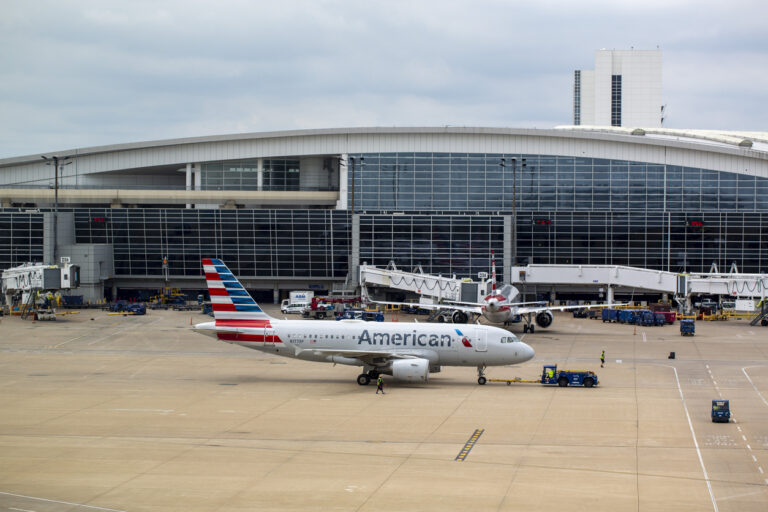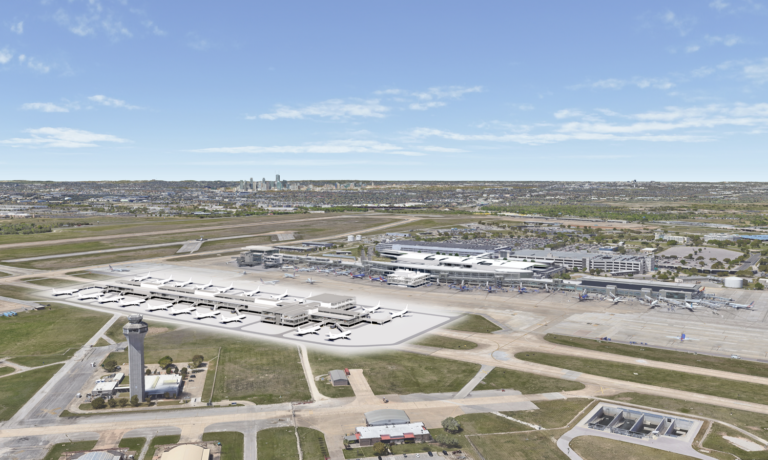

Dallas-Fort Worth International Airport and American Airlines announced Monday that they will build a sixth terminal at DFW and make improvements to existing Terminal C — work representing a capital package worth between $3 billion and $3.5 billion. The airport is making the investment as part of a long-term commitment from American to operate out of DFW.
Design work for Terminal F, which will be located south of Terminal D, is slated to start immediately and will include a flexible design that will enable the airport to open the new terminal by 2025 and to phase in up to 24 gates as needed. Improvements at Terminal C, which was built in 1974, are expected to mirror changes completed at Terminals A, B and E in 2018. These include new check-in areas, larger security checkpoints, more space for concessions and upgrades to lighting and flooring.
Terminal F’s design details are expected to be worked into the new lease American and DFW are currently negotiating. The cost of the new terminal and existing facility renovations is expected to be financed by bonds and repaid via airline rates and charges.
Airports all over the U.S., many of which were built in the 1960s and 1970s, are undergoing expansions and renovations. According to the Airports Council International-North America, U.S. airports will need $128 billion of improvements in the next five years to keep up with passenger and airline demands. One of those is the New Orleans International Airport, which will unveil its new $1.3 billion terminal later this year. That facility will feature 35 gates and 14 TSA lanes.
Airport projects of this size are massive undertakings that require a significant amount of upfront design work, planning and investment, which is why it came as such a surprise to many when, amid accusations of corruption, Mexican President Andres Manuel López Obrador pulled the plug on the new $13 billion Mexico City airport, which was already 30% complete. Since then, López Obrador and his administration have come up with a dual-airport solution, one that has the local business community concerned about flight transfers and other logistical issues since the two facilities are about 30 miles apart.
As the plan currently stands, the existing Mexico City airport will be upgraded and work in coordination with a new airport that will be built at an existing air force base north of the city. That project is expected to get underway in June.
Source: Construction Dive