

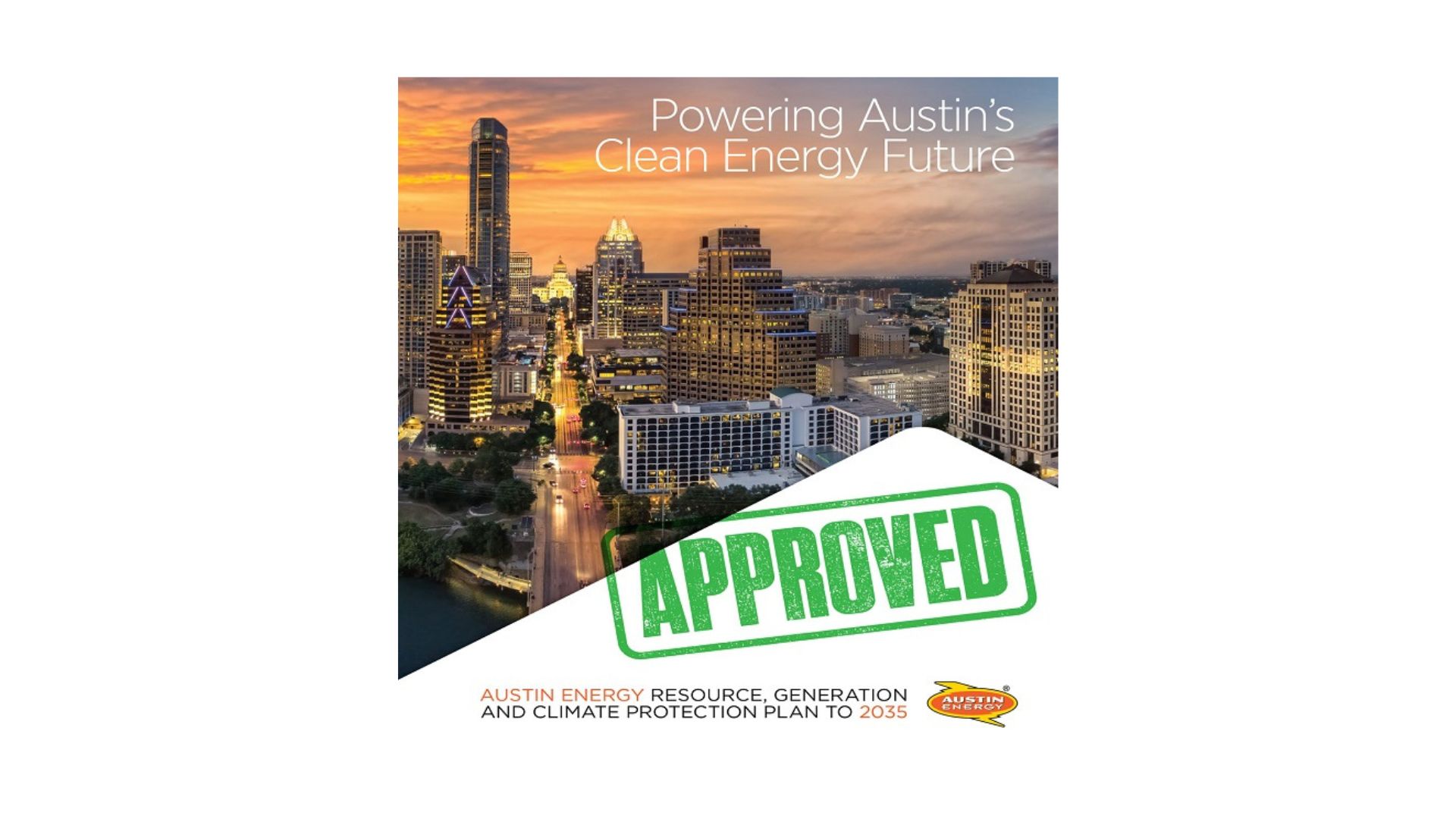
AUSTIN — The Austin City Council unanimously adopted Austin Energy’s Resource, Generation and Climate Protection Plan to 2035 on Thursday, Dec. 12, 2024.
According to a news release, the plan will provide a flexible path to a clean energy future that incorporates the community’s core values of reliability, affordability, environmental sustainability and energy equity.
“We are extremely grateful to Austin City Council and our many community partners and industry experts who played a vital role in shaping Austin Energy’s future,” said Bob Kahn, Austin Energy General Manager. “We are confident that this plan provides the flexibility Austin Energy needs to meet the challenges ahead while reflecting the priorities of our community.”
According to a news release, Austin Energy developed this plan at the direction of the Austin City Council and in partnership with a broad cross-section of 40 diverse organizations, industry experts and community voices. The 2035 plan allows the utility to address the immediate risks affecting the community, including increased electricity demand, projected reliability risks from insufficient local generation, limited capacity on transmission lines and risks from extreme weather events.
“A big part of this plan is readying ourselves to get out of Fayette Power Project,” said Mayor Kirk Watson. “There must be replacement power to protect customers from energy shortfalls and additional energy market risks. For those who share the goal of getting out of coal, this plan is a step forward.”
The 2035 plan builds on the strategies of the Resource, Generation and Climate Protection Plan adopted by city council in 2020 and reportedly gives the community:
- Continued progress to an industry-leading goal of 100% carbon-free energy by 2035.
- Prioritized customer energy solutions including enhanced demand response and energy efficiency programs, expanded solar options and greater use of customer-installed battery storage.
- Phasing out coal and expanding energy portfolio with more clean, renewable resources such as wind and solar.
- Leveraging local solutions, such as utility-scale batteries and peaker units, to increase reliability during extreme weather events.
- Furthering the culture of innovation by exploring advanced nuclear and geothermal technologies, expanding research and development partnerships, and integrating virtual power plants and other cutting-edge solutions.
“I’m incredibly proud of this Council and the Austin Energy team for building one of the strongest, most environmentally responsible plans in the country – carbon-free by 2035,” said Lisa Martin, Austin Energy Deputy General Manager and Chief Operations Officer. “This plan provides the tools to deliver reliable electricity, keep customer bills low and help the most vulnerable in our community.”
For more information about plan, visit publicinput.com/generation.
Source: City of Austin