
AUSTIN — Motorcyclists are much more vulnerable to crashes and can be harder to spot for other drivers. Because of this, motorcyclists have a higher risk of being injured or killed in crashes compared to people in cars.
The number of motorcyclist deaths in Texas has increased every year since 2020. During Motorcycle Safety Awareness Month this May, TxDOT is asking everyone to look twice for motorcycles.
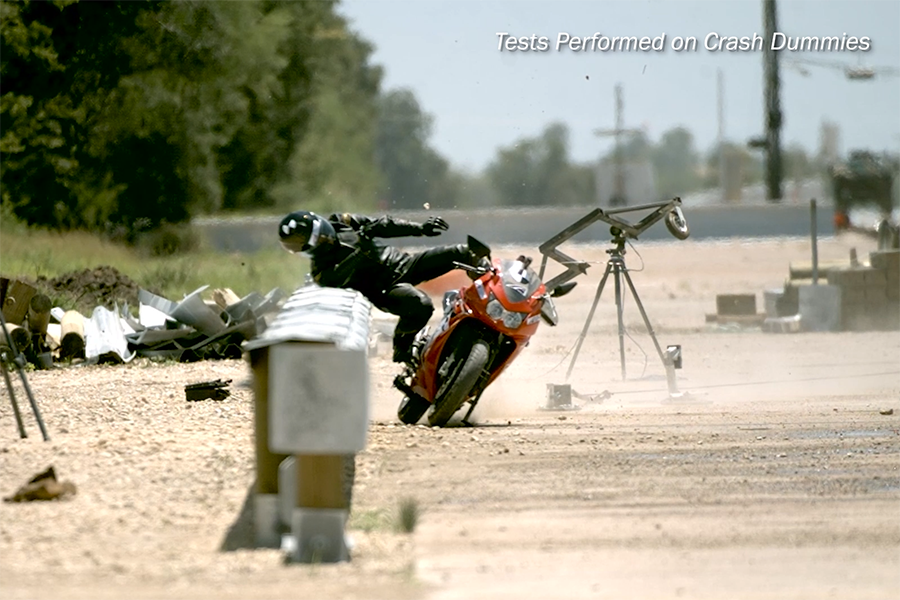
To help improve safety for motorcyclists, TxDOT looked into some of the factors causing severe injuries during motorcycle crashes. One contributing factor is guardrails. These barriers designed to help improve safety can act as a blunt force object for motorcyclists if riders hit a guardrail in a crash or spin-out.
Researchers at the Texas Department of Transportation Research and Technology Implementation Division and Texas A&M Transportation Institute noticed a consistent correlation between the number of barrier-related motorcycle fatality increases and the total number of motorcycle riders increasing over time. In addition, statistics show more fatal motorcycle-guardrail collisions than car-guardrail collisions.
The five-year project investigated what components of guardrails most contributed to severe and fatal injuries for motorcyclists, then created a design that is safer for motorcyclists in the event of a crash that can be retrofitted onto existing guardrails.
Nathan Schulz, a Texas A&M Transportation Institute research scientist, said the two main components of the retrofit design are a protective cap rail over the top that eliminates sharp edges, and a rub rail along the bottom of the guardrail to keep motorcyclists from hitting a post or sliding past the rail into another hazard.
“This is a safe way to capture and contain motorcycle riders and reduce the potential of serious injury for them,” Schulz said. “At the same time, it’s not negating safety for passenger vehicles.”
With the new guardrail design, motorcyclists will be more likely to slide along the top of the rail or along the side of the road, which can help eliminate blunt force trauma impacts, lacerations and spinal injuries.
Schulz said sensitivity of the head and neck was an imperative consideration in the design of the rub rail. Because these parts of the body are so fragile, the design concepts and configuration options were more limited than originally expected when going into the research.
“We know motorcycle riders are a smaller part of the driving population, but we’re seeing that they’re one of the higher ones as far as fatalities when impacting safety barriers,” Schulz said.
According to Ken Mora, TxDOT roadway standards and research lead, the research at Texas A&M considered many variables, including the factors that may cause motorcyclists to leave the roadway more easily.
“We’re going to be providing some of this guidance in our roadway design manual and will be releasing a motorcycle rub rail standard,” Mora said. “The guidance will include locations where the rub rail should be considered for use and other countermeasures that will hopefully reduce the number of motorcyclists who might leave the roadway and hit a metal beam guard fence,” Mora said.
The rub rail design will be recommended in areas with higher-than-normal motorcycle traffic, areas with a history of roadside departure motorcycle crashes and roads that systemically would be more prone to have motorcycle crashes, like roads with tight curves. The standard for the motorcycle rub rail is currently in development and anticipated to be released later in 2024.
By: Laura Butterbrodt, TxDOT