
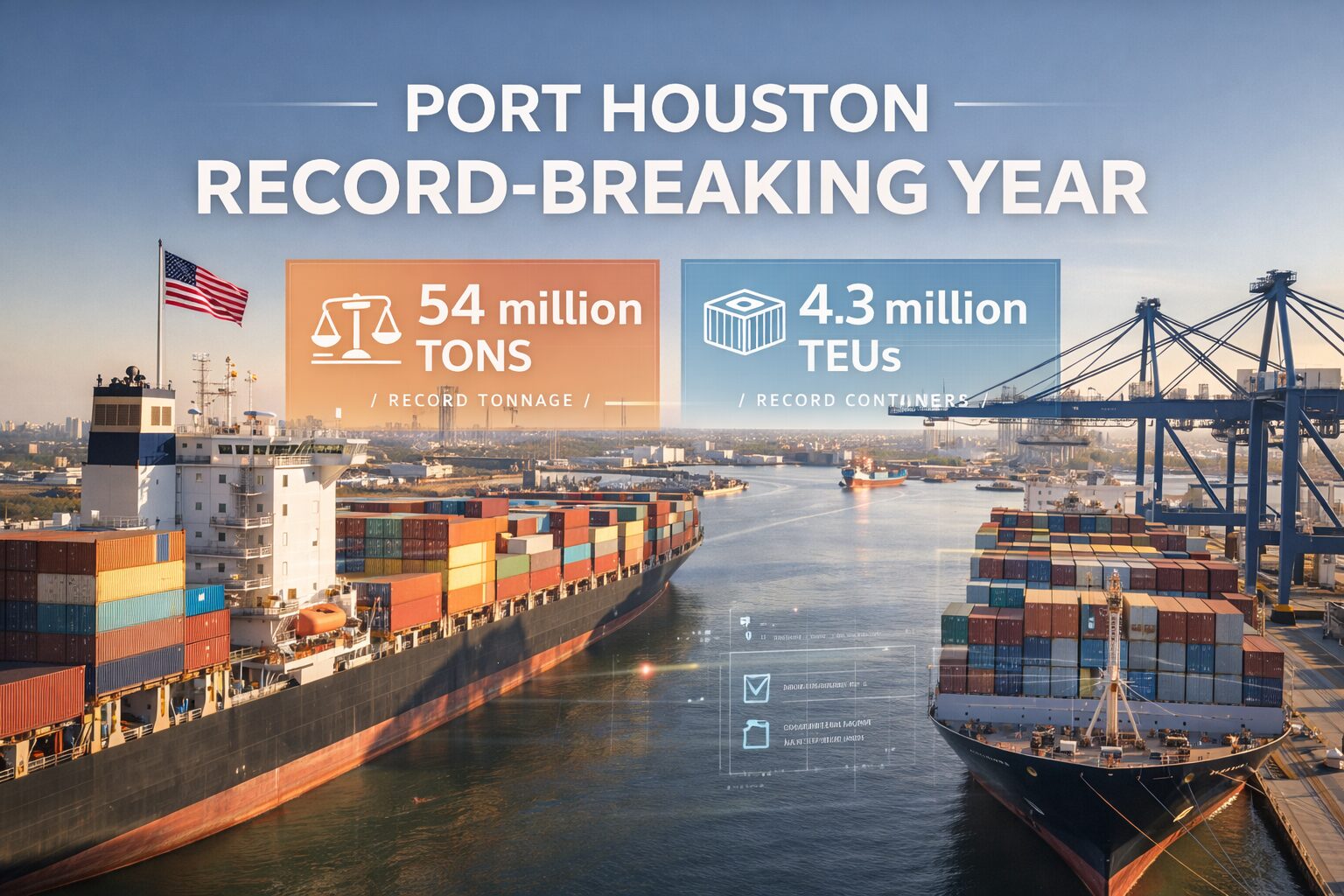
Port Houston Reports Record-Breaking Year as the nation’s leading waterborne tonnage gateway closes 2025 with historic cargo volumes and continued infrastructure expansion. Handling 54,491,066 short tons across its public terminals and achieving a record 4.3 million TEUs, Port Houston’s strong performance reflects resilient global trade activity, growing petrochemical and manufacturing demand, and sustained investment in capacity and efficiency along the Houston Ship Channel.
Port Houston closed 2025 with 3% tonnage growth over the prior year, handling 54,491,066 short tons of cargo across its public terminals in what was the most successful year in the Port’s history. This outstanding performance in 2025 was supported by a strong mix of cargo, including petrochemical and industrial shipments, manufacturing-related freight, and consumer-driven imports.
While down 3% for the month of December, annual container volumes totaled 4,303,345 TEUs in 2025, a 4% increase over 2024, marking a record year for container volumes. Loaded exports increased 7% in 2025, while loaded imports increased 1% for the year. Record growth in containers despite market volatility during much of the year underscores Port Houston’s strong investments in infrastructure and customer demand.
Port Houston is the advocate and strategic leader for the Houston Ship Channel, which includes more than 200 private and eight public terminals and is by far the nation’s largest port for waterborne tonnage and busiest in terms of vessels. Vessel activity along the Houston Ship Channel totaled 8,099 arrivals through December, a 4% decrease compared to 2024. Barge activity totaled 209,616 moves through year-end. Increases in chemical tankers, bulk, and general cargo reflected continued demand for petrochemicals, crude oil, plastics, and machinery moving through the Channel.
“In a year shaped by uncertainty across global trade, it’s remarkable that at Port Houston we reached record levels of both TEUs and total tonnage,” said Charlie Jenkins, CEO of Port Houston.
“This is a reflection of the strong industrial and consumer market in our region and the low-cost, high-service, low-risk environment we offer our customers.”
Infrastructure investments in 2025 at Port Houston’s public terminals enhanced both capacity and efficiency. Just before the end of the year, Port Houston completed Wharf 7 at Bayport Container Terminal, adding 1,000 feet of berth space. This wharf, along with supporting infrastructure, adds more than half a million TEU to Bayport’s capacity. The Port also received five new rubber-tired gantry cranes (RTGs) at Bayport to support expanded terminal operations and improve flow. An additional six RTGs are scheduled to arrive in March, completing the Port’s recent 16 RTG-crane order and bringing the total fleet to 163 across Bayport and Barbours Cut Container Terminals.
Also in 2025, Port Houston completed full implementation of RTG-O at its container terminals, delivering up to a 20% improvement in RTG productivity and supporting improved cargo fluidity and terminal performance. Operational activity remained strong throughout the year, with approximately 2.5 million trucks served and more than 3.3 million transactions completed through December, with an average truck turn time of about 40 minutes.
At Port Houston’s multi-purpose terminals, steel volumes totaled 4,176,166 short tons in 2025, a decline of 8%. General cargo volumes finished 6% below 2024 levels and bulk was up 12% compared to 2024.
Looking ahead to 2026, Port Houston will remain focused on delivering reliable, efficient service for customers. In fact, Port Houston has $2.1 million in planned landside capital investments over the next five years to improve capacity and support cargo fluidity across the public terminals.
Summary:
Port Houston Reports Record-Breaking Year, closing 2025 with historic cargo volumes of 54.5 million short tons and a record 4.3 million TEUs. Strong container growth, rising petrochemical and industrial shipments, and strategic infrastructure investments—including new wharf space and advanced cranes—helped the port maintain top performance despite market volatility. With continued improvements in terminal efficiency and plans for $2.1 million in landside investments over the next five years, Port Houston is setting new benchmarks for U.S. port operations, capacity, and reliability. Discover how the nation’s largest port is driving trade, supporting local industry, and shaping the future of global logistics.
Source: Port Houston