
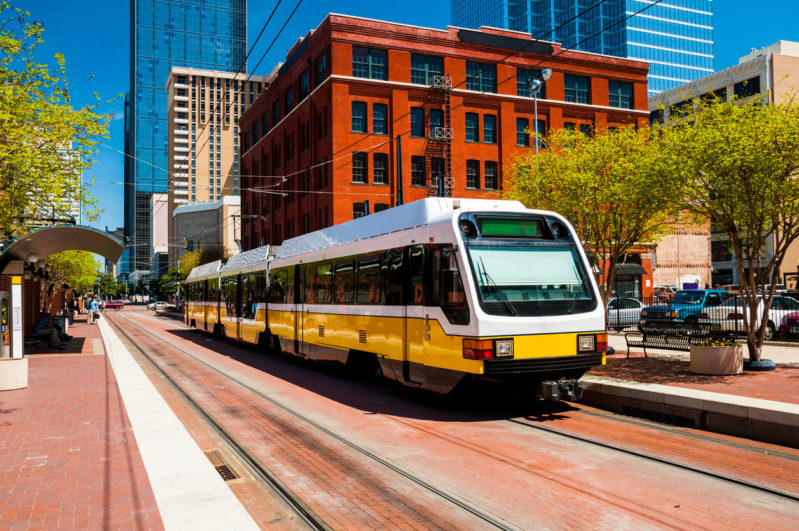
A new study looking at the economic impact of publicly funded projects near the light rail stations of Dallas Area Rapid Transit demonstrates what economists and private real estate developers have seen for nearly two decades: DART Rail is driving the North Texas economy.
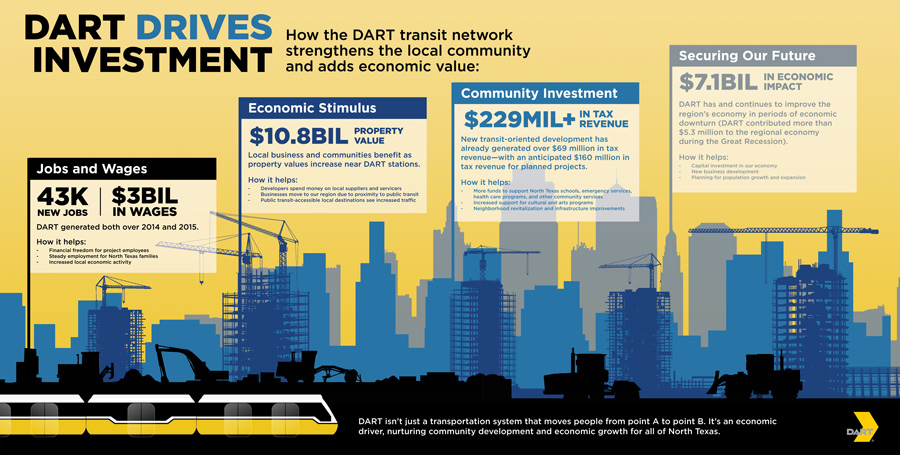
Researchers from the Economics Research Group at the University of North Texas, led by Michael Carroll, Ph.D., looked at 11 public projects, like Parkland Hospital, the Irving Convention Center or the Hatcher Station Health Center between 1999 and 2015 and found those types of projects are valued at $1.8 billion. Combined with privately funded transit oriented development, $10.8 billion has been invested near or along DART’s 93-mile light rail system since 1999.
The updated study was presented at a meeting of the Urban Land Institute on May 11. Previous studies by UNT researchers looked at TOD projects like Mockingbird Station or CityLine and identified more than $7 billion in economic impact from new or planned construction within a quarter mile of rail stations.
Researchers concluded the projects studied “represent not only the region’s commitment to multimodal transportation options and an urban landscape that reflects the importance of those options, but billions of dollars in economic activity and tens of thousands of jobs throughout the region.”
Carroll added, “This proves the wisdom of regional leaders in building a regional transit network like DART.”
Growing the economy while advancing smart growth
The 93-mile light rail system, the nation’s longest, was built at a cost of $5.5 billion. The most recent extension, three miles, connecting a renewed Ledbetter Station to the campus of the University of North Texas Dallas, opened Oct. 24.
“Public transportation transforms cities,” DART President/Executive Director Gary Thomas says. “It not only provides connections to great destinations; it can be the catalyst for economic growth and community renewal.”
More information about DART and transit oriented development is available at DART.org/EconomicDevelopment.
Source: DART.org