
Employment in Texas’ Upstream Oil and Natural Gas Activities Impacted by Pandemic

Data from the Workforce Commission indicates that employment in Texas’ upstream oil and natural gas activities fell significantly in April.
5 22 upstream jobs

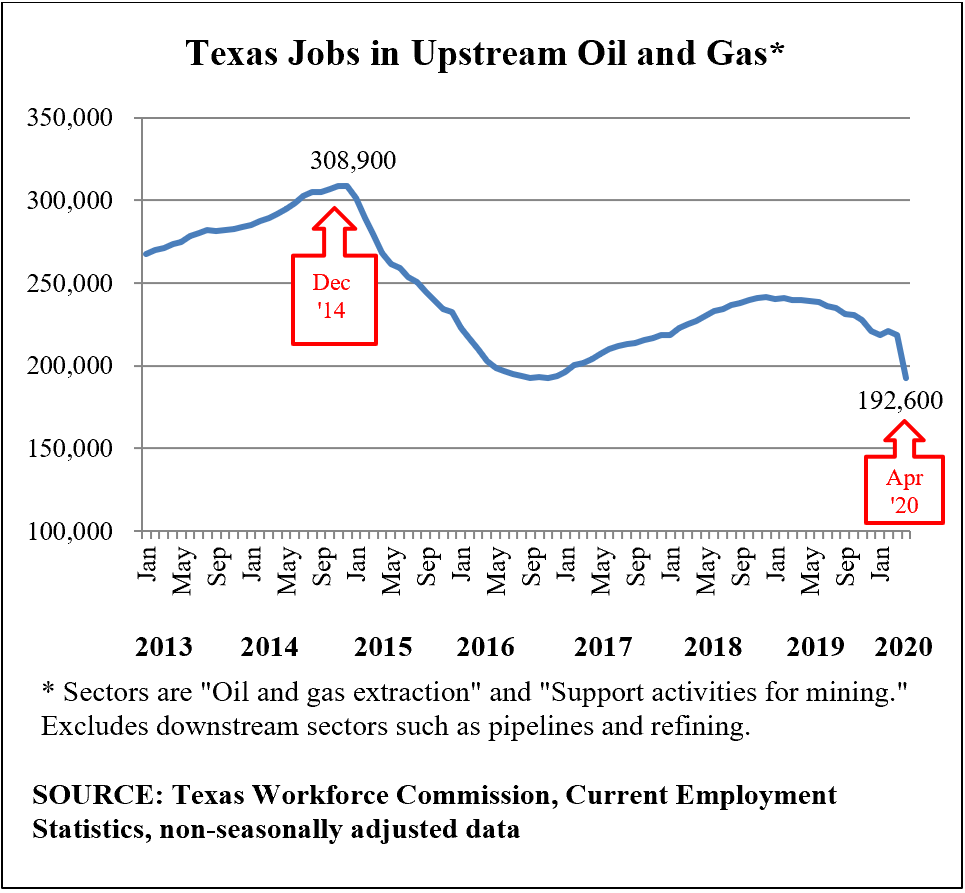
Compared to March 2020 levels, April upstream employment was down by 25,800 jobs.  Compared to the same month in 2019, April 2020 jobs were down 47,200, or 20%.  At a total of 192,600 jobs, this was the first time for upstream jobs to number fewer than 200,000 since January 2017.  The April 2020 upstream job count now essentially matches the low point of September 2016, which was 192,400 jobs.  These jobs pay among the highest wages in Texas.

Todd Staples, president of the Texas Oil & Gas Association, said, “This current crisis is impacting every sector of the oil and natural gas industry, and unfortunately, many companies are required to make difficult decisions as they adjust to the market circumstances. The Texas oil and natural gas industry has positioned itself to manage through the world-wide disruption by immediately announcing rig reductions, curtailing planned capital expenditures for 2020 by over $60 billion and counting, shutting in actual production and by pursuing innovative storage expansion. While many of these necessary reductions have negatively impacted workforce levels, the industry is poised to rebound as the world economy gets back on track and supply/demand levels normalize. We look forward to expanding the employment levels as market conditions allow.”

Oil and natural gas extraction is upstream activity, meaning that it excludes other sectors in the industry such as refining, petrochemicals, fuels wholesaling, oilfield equipment manufacturing, pipelines, and gas utilities.  The employment shown also includes “Support Activities for Mining,” which is mostly oil and natural gas-related but includes some small amount of other types of mining, also.

Of the year-over-year loss of 47,200 jobs, the lion’s share was in the “Support Activities of Mining” sector, mostly service companies.  April 2020 employment by these companies was down 26% compared to the same month, prior year.  For “Oil and Gas Extraction,” which is mostly operators, the year-over-year decline was just 6%.

The “Petroleum and Coal Products Manufacturing,” a subsection of the downstream sector, lost 1,400 jobs (6%) in April 2020 compared to March, an unusual job swing for this sector.
Similar Posts

  • OP-ED: Offshore Exploration Promises Jobs, Affordable Energy

    FacebookXRedditPinterestEmailLinkedInWhatsApp Strong U.S. natural gas and oil production is revitalizing communities in state after state. It’s well-known that increased energy production has cut costs for families – at the pump and in-home utility bills. But leading the world in production has also given U.S. businesses a leg up, generating a manufacturing resurgence. To list just…

  • ConocoPhillips Heads Diversity and Inclusion Efforts in the Oil and Gas Industry

    FacebookXRedditPinterestEmailLinkedInWhatsApp By Stacy M. Brown, NNPA Newswire Senior National Correspondent With projections that half of its workforce will consist of minorities by 2040, the oil and gas industry has continued to recruit individuals of color, women, veterans, and groups that have been mainly underrepresented. At ConocoPhillips, Shawn Green and Maalika Moore-Thomas each take an optimistic…

  • Calpine, ExxonMobil Sign CO2 Transportation and Storage agreement for Power Generation Project

    FacebookXRedditPinterestEmailLinkedInWhatsApp Exxon Mobil Corporation announced an agreement with Calpine Corporation, the nation’s largest producer of electricity from natural gas, to transport and permanently store up to 2 million metric tons per annum (MTA) of CO2 from Calpine’s Baytown Energy Center, a cogeneration facility near Houston. This is part of Calpine’s Baytown Carbon Capture and Storage (CCS)…

  • OPEC Secretary General Visits the United States

    FacebookXRedditPinterestEmailLinkedInWhatsApp By Subcontractors USA News Provider OPEC Secretary General, HE Mohammad Sanusi Barkindo, has embarked on a recent week-long visit to the United States for meetings with the International Monetary Fund, the United States Energy Information Administration, the Center for Strategic and International Studies, the United States Commodity Futures Trading Commission, Columbia University and IHS…

  • Harris County Commissioners Rodney Ellis and Adrian Garcia Develop a $200,000 Disparity Study Fund To Help Entities Implement MWBE Programs

    FacebookXRedditPinterestEmailLinkedInWhatsApp A disparity study determines whether a government entity, either in the past or currently, engages in exclusionary practices in the solicitation and award of contracts to minority, women‐owned, and disadvantaged business enterprises (MWDBEs). This study can help determine if there is disparity between the availability of firms and the utilization of those firms in…