
A 3D Printed Solution for Oil and Gas Valves is helping address a costly manufacturing challenge that can impact pipeline reliability and operational performance. A team of Texas A&M University engineering students, working in collaboration with bp and additive manufacturing company Howco, successfully redesigned a valve seat using metal 3D printing technology. Their innovative approach reduced warping during production, improved part reliability and demonstrated how additive manufacturing can solve real-world problems in the energy industry.
When a metal valve seat fails in an industrial pipeline, it can lead to a gas leak, a production shutdown and thousands of dollars in repairs. In the oil and gas industry, that small sealing ring carries a lot of responsibility. A senior capstone team within the Department of Materials Science and Engineering at Texas A&M University spent the 2025–26 academic year trying to solve this issue.
Sponsored by bp and supported by additive manufacturing company Howco, the team tackled a persistent manufacturing problem: valve seats were warping during production before they ever reached service. Malia Moseley, senior materials science and engineering major at Texas A&M, described the issue plainly: the parts were bending “in a Pringle or a saddle shape, which would reduce their lifespan and make them less effective.”
The team’s goal was to redesign the seat using metal 3D printing, producing a flat, reliable part without the extra processing steps conventional methods require.
Two semesters later, they had done it. Getting there was harder than any of them expected.
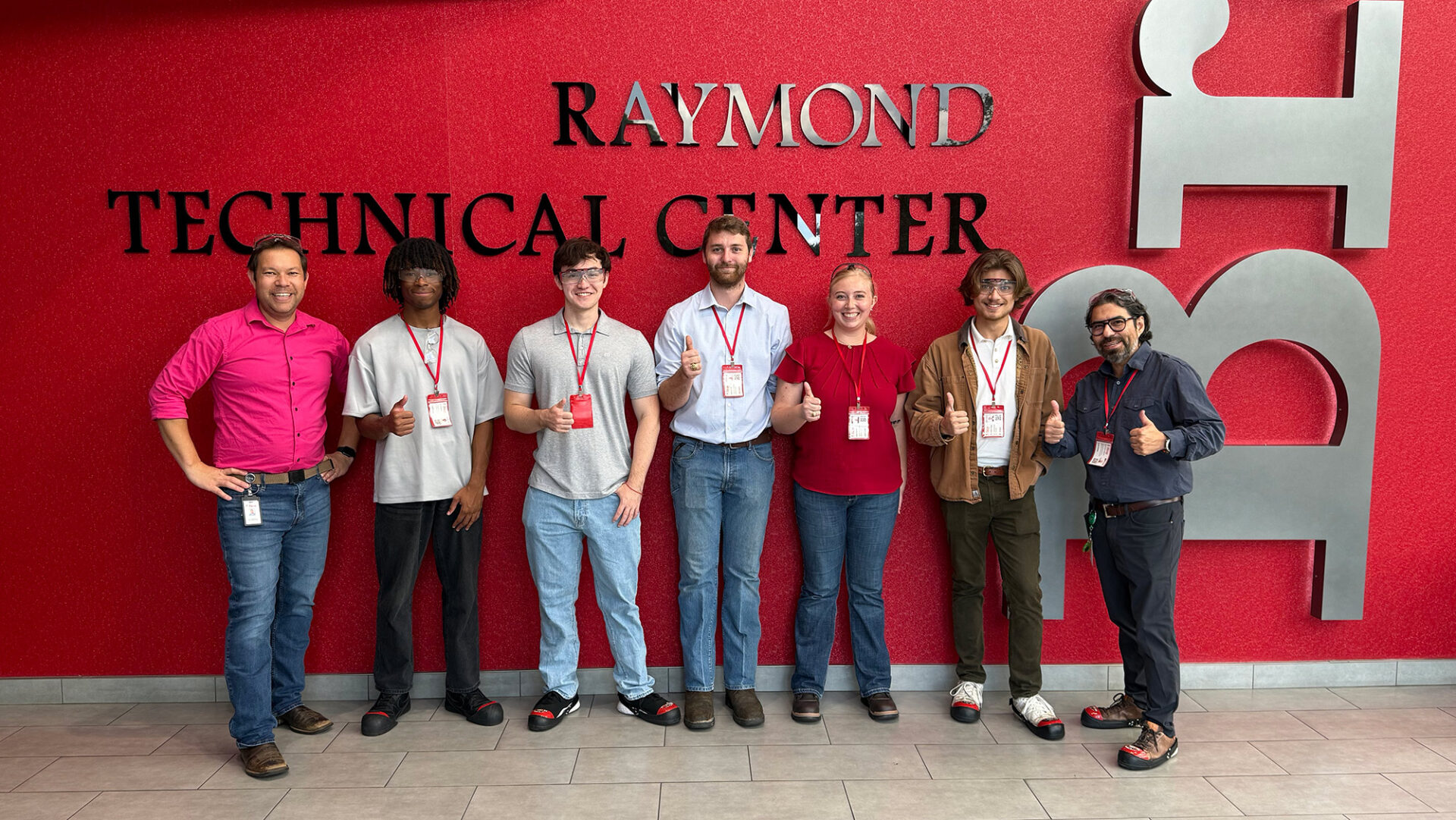
Derrick Harrington, Malia Mosely, Zachary Lau and bp sponsor Arturo Ruiz-Aparicio.
A rocky start
The first semester tested the team more than the technology. Without clear roles or a defined direction, the group spent weeks researching and discussing instead of building. By mid-fall, they still had no vendor, no material and no evaluated design concepts to show.
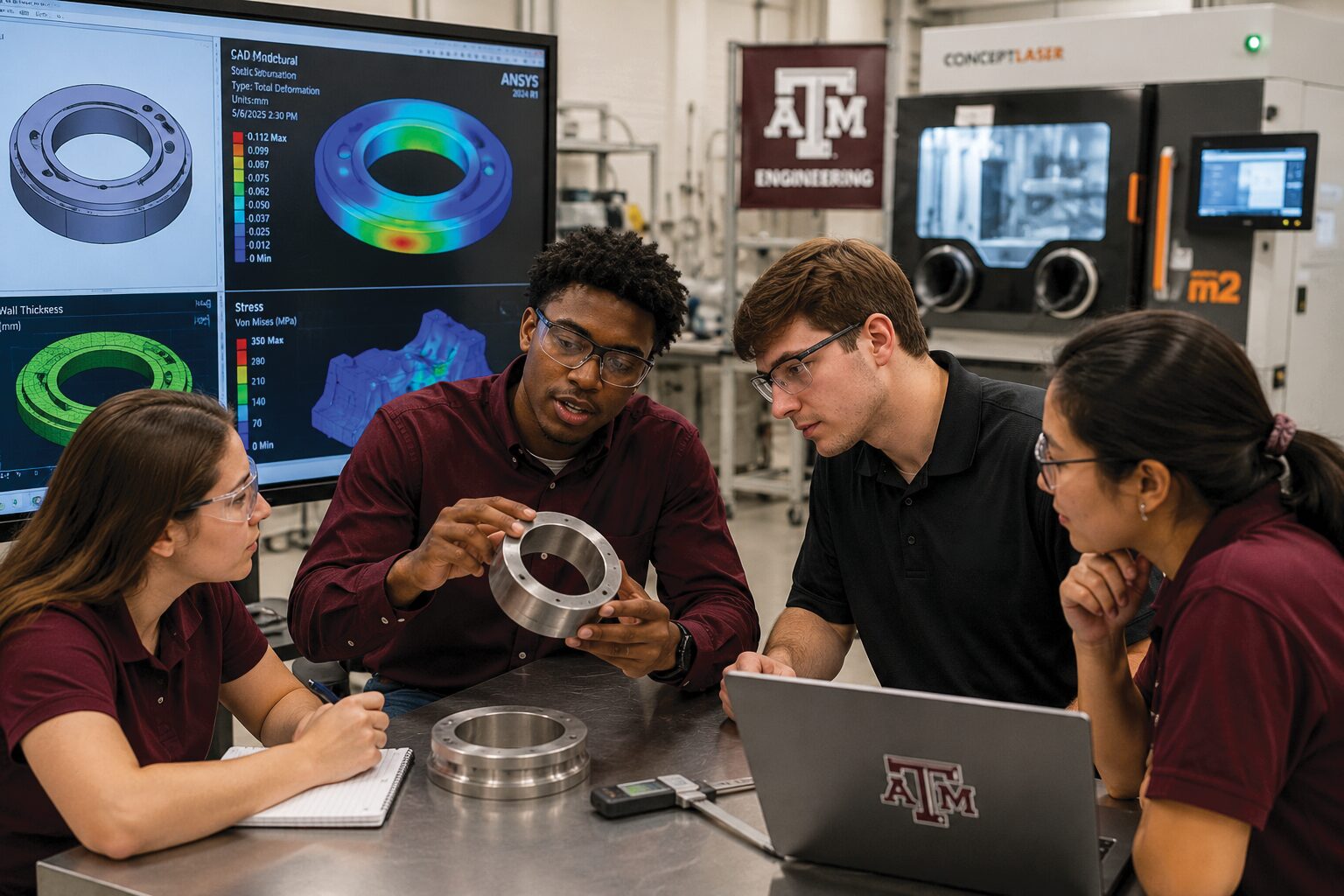
Progress came when the team reorganized. They split the work into specific areas, including CAD design, finite element analysis, manufacturing coordination and documentation, giving each team member ownership over their part.
“Team members were able to focus more deeply on their respective tasks with hard deadlines and purpose, leading to higher-quality outputs and faster progress,” said Afiz Ashittu, team leader and senior materials science and engineering major.
By their presentation at the end of the fall semester, they were no longer pitching ideas. They were presenting results. Derick Harrington, senior materials science and engineering major, described the relief of walking out of that presentation without a single critical question from the panel.
“It made us feel like we had done well and were headed in the right direction,” he said.
What industry brought to the table
Howco and bp each contributed something the team could not have replicated on its own.
The students received access to an active company blueprint through bp under a non-disclosure agreement. Harrington noted the difference it made.
“Classes only had publicly available sample designs that didn’t have as much depth as a real company’s final design,” he said.
Working from a real blueprint, every design decision is grounded in operational requirements. According to bp, the results held up. The redesign used additive manufacturing to vary wall thickness across the seat and add stiffening ridges where the original design was weakest, improving reliability and reducing the risk of costly valve failures in the field.
Howco provided manufacturing access and technical guidance to help the team successfully develop the 3D Printed Solution for Oil and Gas Valves.
Their engineers walked students through the specific constraints of metal additive manufacturing, such as build orientation, thermal distortion and support structure strategies that simply don’t come up in coursework.
“Their documentation, communication with our team and willingness to revisit assumptions throughout the project mirrored the type of workflow we see in professional engineering teams,” said David Ramirez, business development manager with Howco.
When test specimens came back slightly oversized for standard tensile testing equipment, the team switched to a three-point bend test rather than starting over. The adjustment proved to be an improvement, yielding both tensile and compressive data all in a single test.
What stays with them
Technical skills matter. But the students pointed to something harder to teach as they reflected on what they learned.
“This project required me to define the problem, determine the approach and continuously adapt as new challenges arose,” Ashittu said. “Learning how to operate in ways that don’t have a right or wrong answer yet has been one of the most impactful takeaways.”
Moseley put it more simply. “This project prepares me for the reality of work,” he said. “It changes how I view problems to be solved.”
For bp and Howco, the return on that investment extends beyond any single project.
“Even if we are not in a position to hire students at that time, we have helped them and the larger engineering community by investing in students that are sure to be future industry leaders” said Dr. Charlie Ribardo, principal engineer with bp.
Because someone invested in this capstone program, these students leave with more than a degree. They leave ready.
Summary
This 3D Printed Solution for Oil and Gas Valves emerged from a year-long Texas A&M capstone project sponsored by bp and supported by Howco. The student team was tasked with solving a manufacturing issue that caused valve seats to warp before entering service, potentially leading to reduced performance and costly failures. By leveraging metal additive manufacturing, the team redesigned the valve seat with optimized wall thickness and reinforcing features that improved structural stability and reliability. Along the way, the students gained hands-on experience working with real industry blueprints, engineering constraints and manufacturing processes. The project highlights how collaboration between academia and industry can drive innovation while preparing future engineers to solve complex challenges in the oil and gas sector.